For growing Indian SMEs and enterprises, processing monthly payroll often feels like navigating a maze. Juggling erratic shift allowances, calculating accurate overtime hours from raw punch-in logs, and manually filing Provident Fund (PF) and Employee State Insurance (ESI) deductions consume countless productive hours. Even worse, manual intervention frequently leads to calculation discrepancies, employee dissatisfaction, and compliance penalties.
The ultimate antidote to these operational bottlenecks is a payroll management system with biometric integration. By directly syncing biometric hardware data with your payroll engine, businesses can transition from error-prone spreadsheets to a frictionless, automated workflow.
1. The Hidden Costs of Manual Attendance and Payroll Processing
Traditional attendance management—whether maintained through manual registers or disconnected punch-card machines—creates severe administrative friction:
The Spreadsheet Trap: HR teams waste days manually transposing Excel sheets from biometric devices into payroll templates, leaving ample room for data entry errors.
Shift Calculation Complexities: Night shifts, rotational shifts, and split shifts involve varying allowance structures that are notoriously difficult to track manually.
Overtime Disputes: Discrepancies in calculating fractional overtime hours often trigger employee grievances and erode trust.
Statutory Miscalculations: Manual calculation of Employee Provident Fund (EPF) and ESI ceilings, voluntary PF contributions, and professional tax slabs exposes companies to audit risks.
2. How Biometric-to-Payroll Integration Works
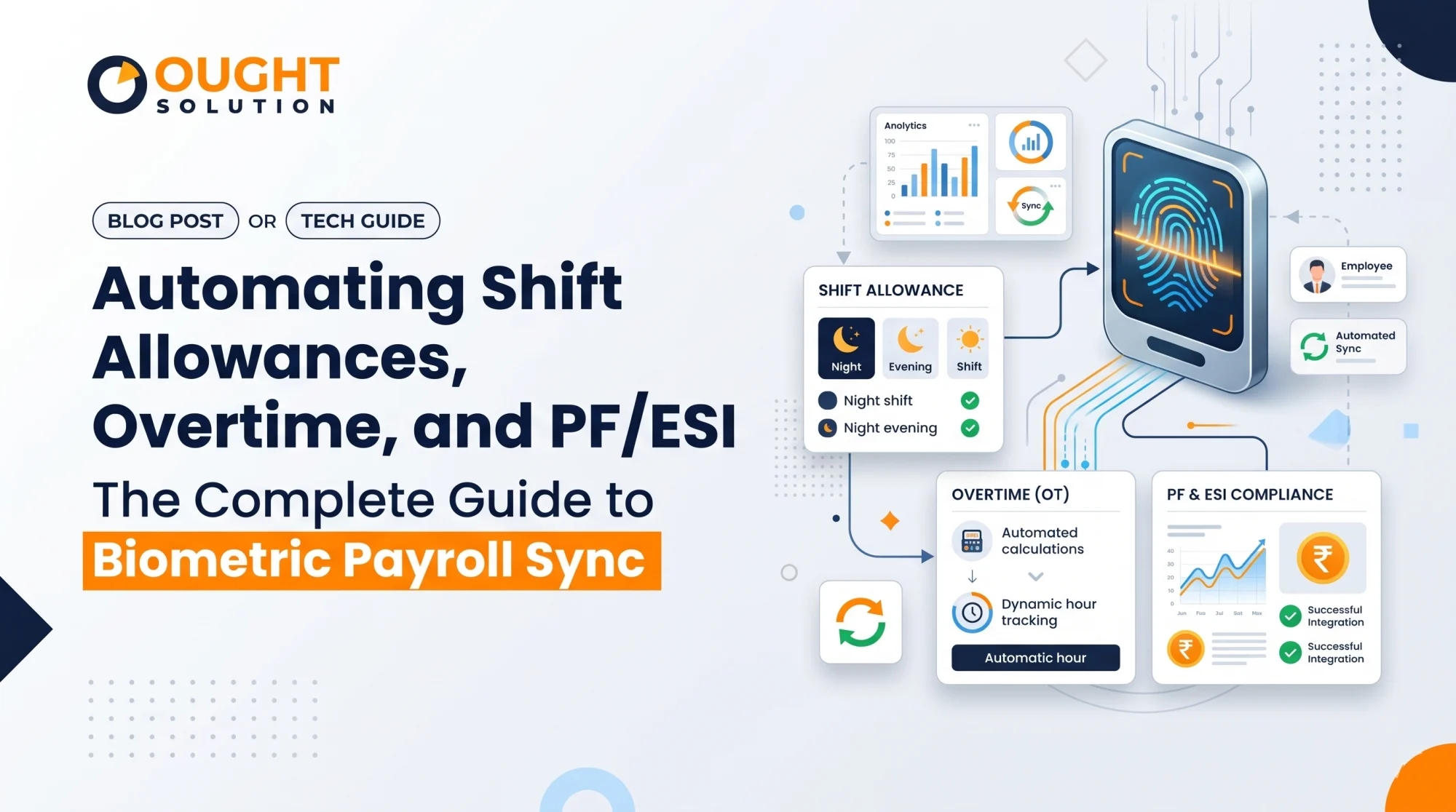
A modern integrated payroll ecosystem bridges physical attendance tracking with cloud-based financial processing through secure API bridges.
[ Biometric Device / Facial Recognition ]
                 ↓ (Real-Time API Sync)
    [ Attendance & Shift Engine ]
                 ↓ (Automated Rule Application)
 [ Overtime & Allowance Calculation ]
                 ↓ (Statutory Deduction: PF / ESI)
      [ Final Net Pay & Payslip ]
Real-In / Real-Out Capture: Employees authenticate via fingerprint, facial recognition, or RFID cards. The device logs precise timestamps.
Automated Policy Application: The payroll software ingests these timestamps and applies company-specific policies (e.g., grace periods, late-coming deductions, half-day rules).
Dynamic Calculations: Shift differentials, holiday allowances, and authorized overtime are automatically quantified and factored into the gross earnings.
3. Automating Complex Shift Allowances and Overtime
Shift work requires granular tracking to ensure fair compensation without inflating labor costs. Biometric integration streamlines this by:
Mapping Shift Rules: Defining custom rules for night-shift allowances or hazardous duty pay that automatically trigger when an employee logs into a designated shift window.
Precision Overtime (OT) Triggers: Setting threshold parameters (e.g., OT calculation begins only after 30 minutes of post-shift work) to prevent unauthorized overtime payouts while ensuring complete compliance with the Factories Act or Shops & Establishment Act.
Grace Period Management: Automatically distinguishing between occasional traffic delays and habitual late arrivals, applying pre-approved deduction policies without manual supervisor sign-off.
4. Streamlining PF, ESI, and Statutory Compliance in India
Statutory deductions demand absolute accuracy. An integrated biometric payroll system simplifies compliance through built-in automation:
PF Wage Ceiling Tracking: Automatically monitors the statutory wage ceiling for Employee Provident Fund contributions while supporting higher voluntary contributions (VPF) seamlessly.
ESI Eligibility Calculation: Tracks gross monthly earnings to automatically determine ESI eligibility, ensuring no eligible employee is missed while preventing erroneous deductions for those crossing wage thresholds mid-month.
E-Return Generation: Automatically formats monthly contribution files into formats ready for direct upload onto the EPFO and ESIC portals, drastically reducing filing times.
5. Key Benefits for Indian SMEs and Enterprises
Zero Time-Theft: Eliminates "buddy punching" and proxy attendance completely.
Audit-Ready Records: Maintains immutable digital audit trails linking every rupee paid to verified biometric entry logs.
Scalability: Easily handles multi-branch operations, remote site check-ins, and complex multi-tiered workforce structures.
Conclusion
Transitioning to a unified payroll management system with biometric integration is no longer a luxury—it is a strategic necessity for businesses looking to scale efficiently. By removing manual data entry, ensuring ironclad statutory compliance, and building absolute trust through transparent pay calculations, organizations can redirect their focus from administrative firefighting to core business growth.
Ready to transform your HR operations with intelligent payroll automation? Let's discuss how Ought Solution can tailor a robust payroll system for your enterprise.
Ought Solution Admin is the technical editorial and solutions architecture desk at Ought Solution, a global B2B IT consulting, custom ERP software, and biometric hardware integration firm. Drawing from hands-on deployments across Manufacturing Units / Plants, healthcare diagnostics, educational campuses, and corporate…