Time theft remains one of the most silent yet devastating drains on corporate profitability. Whether it is "buddy punching"—where one employee clocks in for an absent colleague—or extended unauthorized breaks, traditional punch cards, PINs, and proximity keycards leave massive loopholes. Employees can easily share credentials, swap key fobs, or log in remotely without stepping foot inside the facility.
Deploying an advanced biometric door access control system completely redefines how enterprises handle both physical security and time attendance. By tying physical entry directly to unique physiological traits, organizations ensure that the person entering the building is precisely the person logging billable hours.
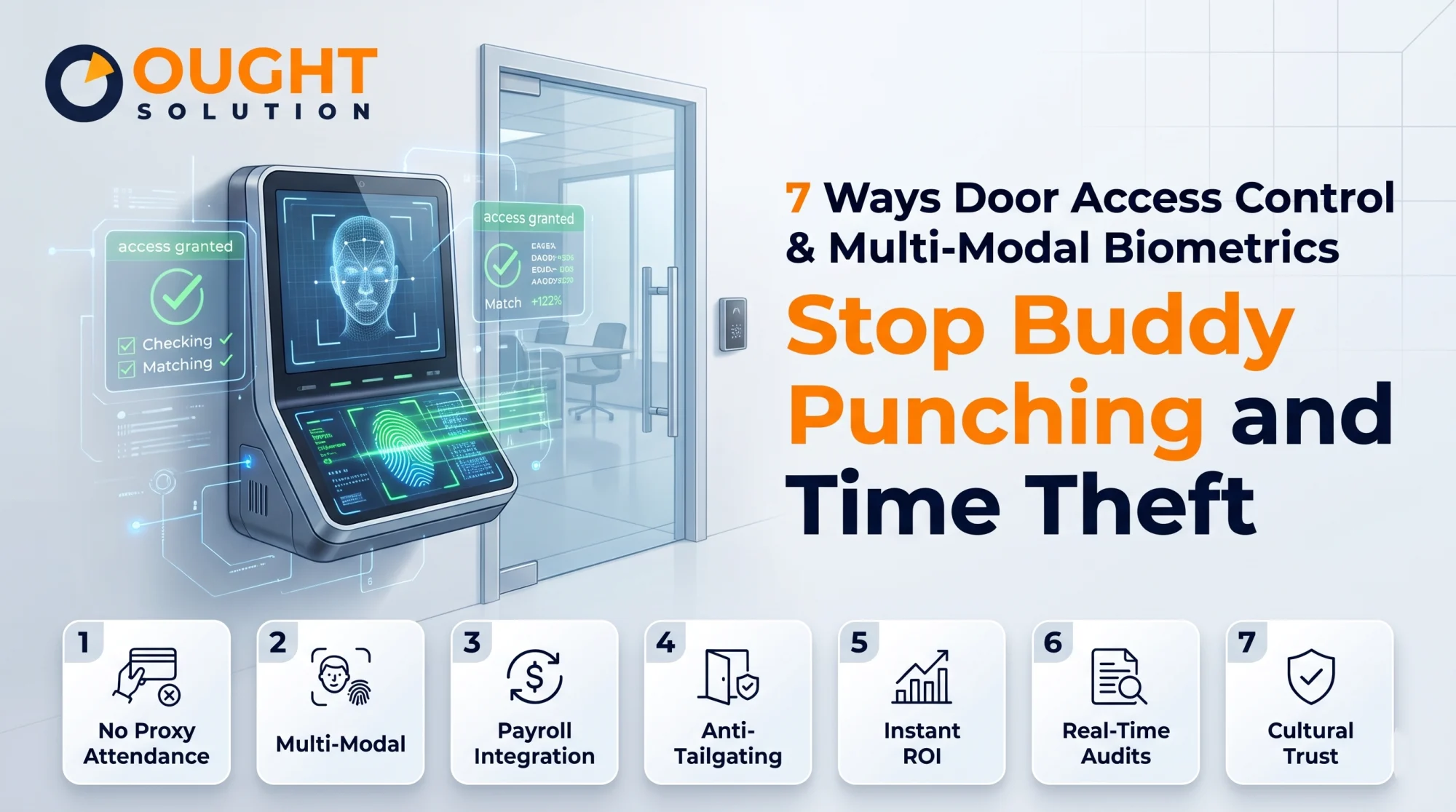
1. Eliminates Proxy Attendance & "Buddy Punching" Forever
Traditional identification methods verify what a person has (a keycard) or what a person knows (a PIN), both of which are easily shared among colleagues. A biometric access control system verifies who the person is. Because biometric markers—such as fingerprints, iris patterns, or facial geometry—cannot be lent out, replicated, or handed to a coworker, proxy attendance and buddy punching are rendered structurally impossible.
2. Multi-Modal Authentication Adds Layered Verification
Modern security standards have moved beyond single-factor fingerprint scanners, which can occasionally be vulnerable to surface wear or dust in industrial environments. Multi-modal biometrics combine two or more distinct verification factors simultaneously—such as facial recognition paired with palm-vein scanning or fingerprint matching paired with RFID credentials. This dual-layer authentication guarantees 100% identification accuracy, eliminating false acceptances even in high-traffic shift changes.
3. Integrates Physical Entry with Automated Payroll
When an access control terminal double-functions as an attendance logger, every door unlock event serves as a verified timestamp. Workers cannot enter the premises without registering an immutable attendance log. This seamless bridge between physical security logs and payroll software eliminates manual data entry errors, administrative overhead, and disputes over shift timings.
4. Secures Restricted Zones Against Tailgating and Unauthorized Access
Time theft isn't just about clocking hours; it also involves unauthorized access to secure floors, server rooms, or inventory storage during working hours. Biometric door locks restrict entry exclusively to authorized personnel. Advanced anti-passback configurations further ensure that an employee cannot use their biometric credential to open a door and immediately pass it back to let an unverified individual slip through.
5. Delivers Immediate ROI by Recovering Lost Payroll
Industry studies consistently show that businesses lose hours of productivity every week to time padding, late arrivals, and early departures. By sealing these leaks through automated biometric enforcement, companies typically recover their capital investment in access control hardware within the first few months of deployment through direct savings on unearned wage payouts.
6. Generates Real-Time Audit Trails for Compliance
Manual timesheets are notoriously easy to alter retroactively. Biometric access control platforms record every single entry and exit attempt in an immutable, timestamped database. Safety officers and human resource managers can pull instant activity logs during audits, tracking exact occupancy numbers during emergencies and verifying compliance with labor regulations.
7. Enhances Workplace Accountability and Cultural Integrity
Beyond the financial metrics, visible deployment of secure biometric entry infrastructure shifts organizational culture. When employees know that attendance tracking is objective, transparent, and impervious to manipulation, accountability improves across all departments. Honest workers no longer feel demoralized by peers who manage to log full hours while arriving late or leaving early.
Conclusion: Secure Your Perimeter and Protect Your Bottom Line
Implementing a robust biometric door access control system does more than upgrade your facility's physical security—it forms the backbone of accurate workforce management. By leveraging multi-modal biometric technology, businesses shut down time theft at the door, protect payroll budgets, and establish a transparent, accountable workplace environment.

Ought Solution Admin is the technical editorial and solutions architecture desk at Ought Solution, a global B2B IT consulting, custom ERP software, and biometric hardware integration firm. Drawing from hands-on deployments across Manufacturing Units / Plants, healthcare diagnostics, educational campuses, and corporate…