Treating search engine optimization as a checklist applied after a website goes live is one of the most expensive mistakes a growing business can make. When search visibility is treated as an afterthought, companies often spend months retrofitting bloated codebases, fixing broken crawl paths, and trying to salvage sluggish page speeds.
True SEO friendly website creation and development starts at the architectural blueprint stage. For businesses competing in global markets, search engines reward websites engineered from the ground up with clean semantic code, instantaneous user responsiveness, and machine-readable structured data.
Here is how modern engineering teams bake technical SEO and Google's Core Web Vitals directly into every stage of the software development lifecycle.
1. Architecting Clean, Crawl-Friendly Code From Day One
Search engine bots operate on a finite crawl budget. If a website relies on tangled JavaScript bundles, redundant DOM layers, or broken internal routing, search crawlers struggle to index critical service pages efficiently.
Modern SEO friendly website creation and development prioritizes:
Semantic HTML5 Structure: Using proper
<header>,<nav>,<main>,<article>, and<section>tags alongside a logicalH1toH6hierarchy so search engines immediately understand content priority and topical relevance.Server-Side Rendering (SSR) & Static Generation: Ensuring full HTML content is immediately visible to search crawlers upon initial HTTP request rather than forcing bots to execute heavy client-side scripts.
Clean URL Taxonomy & Canonicalization: Structuring human-readable, keyword-aligned URLs paired with self-referencing canonical tags to prevent duplicate content issues across regional or parameterized pages.
Automated XML Sitemaps & Robots Governance: Dynamically generating clean XML sitemaps that update automatically when new pages or blog posts are published, paired with precise
robots.txtdirectives.
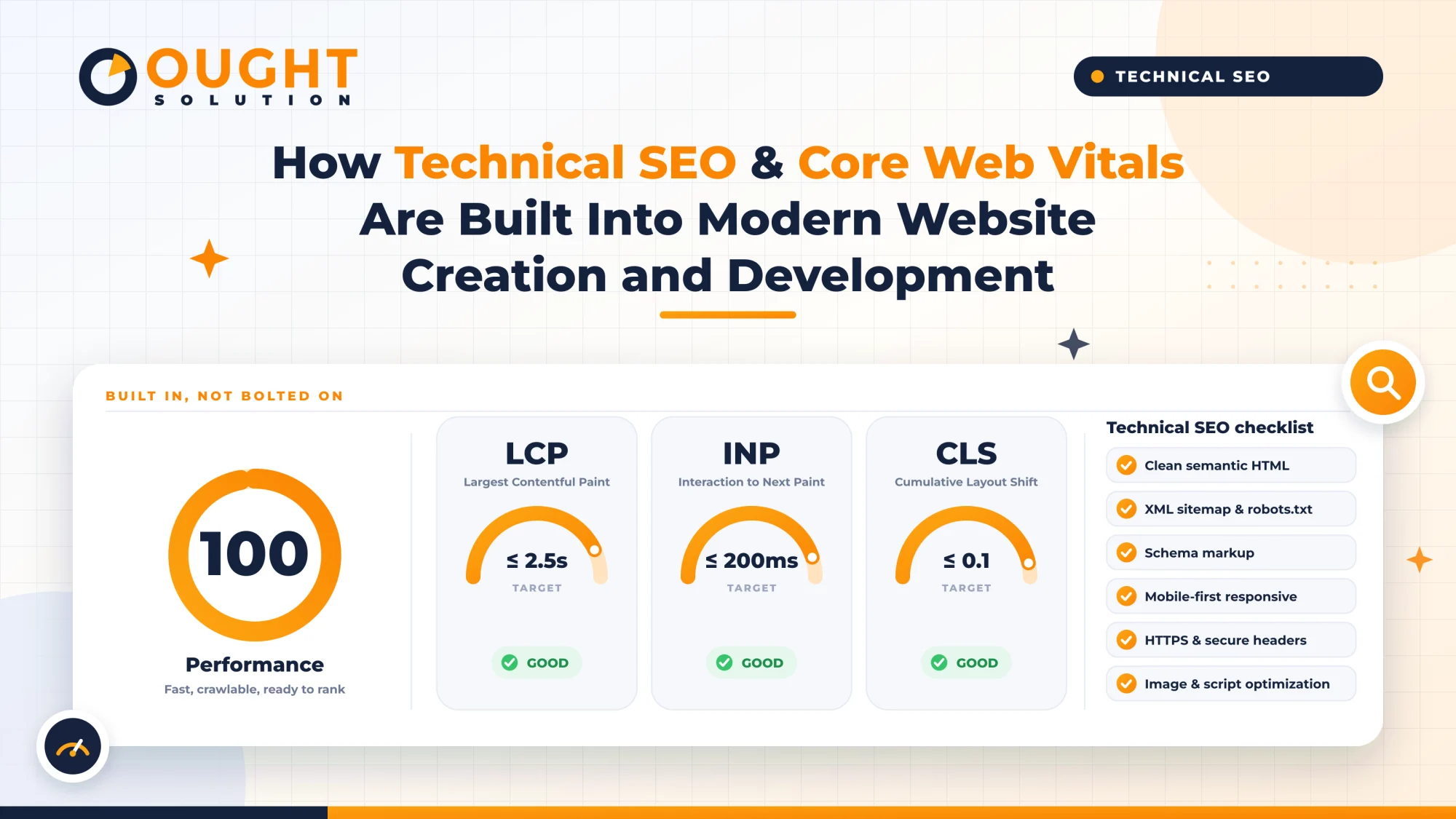
2. Engineering for Google’s Core Web Vitals (LCP, INP, and CLS)
Google uses Core Web Vitals as direct page-experience signals. Rather than relying on generic caching plugins after launch, performance-first development optimizes the three core metrics at the code and server level:
Largest Contentful Paint (LCP) — Target: Under 2.5 Seconds
LCP measures how quickly the primary visual content of a page renders. Developers optimize LCP by:
Serving next-generation image formats (
WebPandAVIF) with explicitfetchpriority="high"attributes on hero banners.Eliminating render-blocking CSS and deferring non-critical third-party JavaScript.
Leveraging edge Content Delivery Networks (CDNs) and HTTP/3 protocols to minimize Time to First Byte (TTFB) for international visitors.
Interaction to Next Paint (INP) — Target: Under 200 Milliseconds
INP evaluates how fast a page responds visually when a user clicks a button, opens a menu, or submits a form. Engineering low INP requires:
Breaking up long JavaScript tasks on the main thread so user interactions are never blocked by background scripts.
Minimizing DOM size and avoiding excessive event listeners on interactive UI components.
Using lightweight, modular backend and frontend architectures instead of heavy, bloated page builders.
Cumulative Layout Shift (CLS) — Target: Under 0.1
CLS prevents frustrating visual jumps while a page loads. Developers eliminate layout shifts by:
Reserving explicit
widthandheightaspect-ratio containers for every image, video, and dynamic embed.Preloading web fonts with
font-display: swapand matching fallback font metrics so text does not reflow abruptly.
3. Embedding Native JSON-LD Schema Markup
Modern search engines—and AI-driven answer engines—rely on structured data to verify entity credibility, services, reviews, and organizational authority.
Instead of leaving rich snippets to chance, developers embed validated JSON-LD (JavaScript Object Notation for Linked Data) directly into page templates:
Organization & LocalBusiness Schema: Establishes brand identity, contact channels, and global or regional service areas.
Service & Product Schema: Clearly defines software solutions, custom web development offerings, and technical specifications for commercial search queries.
Article & FAQPage Schema: Helps educational blog content capture rich search features and direct answer placements on Google.
4. Mobile-First Responsiveness & International Readiness
With Google operating exclusively on mobile-first indexing, responsive design is a baseline technical requirement rather than an optional feature. Every layout grid, typography scale, tap target, and navigation drawer is built for mobile viewports first and scaled up cleanly to desktop displays.
For companies targeting international clients, technical development also incorporates:
Hreflang Tag Architecture: Accurately mapping language and regional variations so users in North America, Europe, the Middle East, or Asia land on the right localized page.
Enterprise Security & HTTPS: Enforcing TLS encryption, HSTS headers, and clean security protocols that protect user trust and ranking integrity.
Build Your Next Website With Technical SEO at the Core
A visually appealing website cannot drive business growth if prospective clients never find it in search results. When clean architecture, sub-second speed, and structured data are built into the foundation of your site, every piece of content you publish gains a lasting competitive advantage.
At Ought Solution, our web development and digital engineering team builds custom, high-performance websites and web applications designed to rank globally. From clean PHP/MySQL and modern frontend architectures to Core Web Vitals tuning and structured schema integration, we ensure your digital presence is engineered for visibility and conversion from day one.
Ready to launch an SEO-first website that outperforms your competition? Explore our custom website creation and development services at oughtsolution.com to get started.

Ought Solution Admin is the technical editorial and solutions architecture desk at Ought Solution, a global B2B IT consulting, custom ERP software, and biometric hardware integration firm. Drawing from hands-on deployments across Manufacturing Units / Plants, healthcare diagnostics, educational campuses, and corporate…