Static brochure websites serve a basic purpose: they introduce your brand and display contact details. However, once a business starts managing dozens of active clients, recurring appointments, subscription tiers, or multi-vendor workflows, a static website quickly becomes a bottleneck. Operations spill over into endless email threads, manual PDF invoicing, and disconnected spreadsheets.
Custom web portal creation and development solves this operational friction by turning your website into an interactive, login-based workspace. Instead of relying on rigid off-the-shelf software that forces you to change how you work, a bespoke web portal is engineered around your exact business logic, user roles, and growth roadmap.
What Is a Custom Web Portal?
A web portal is a secure, centralized gateway that gives specific user groups—such as customers, vendors, partners, or internal staff—personalized access to data, tools, and workflows behind an authentication layer.
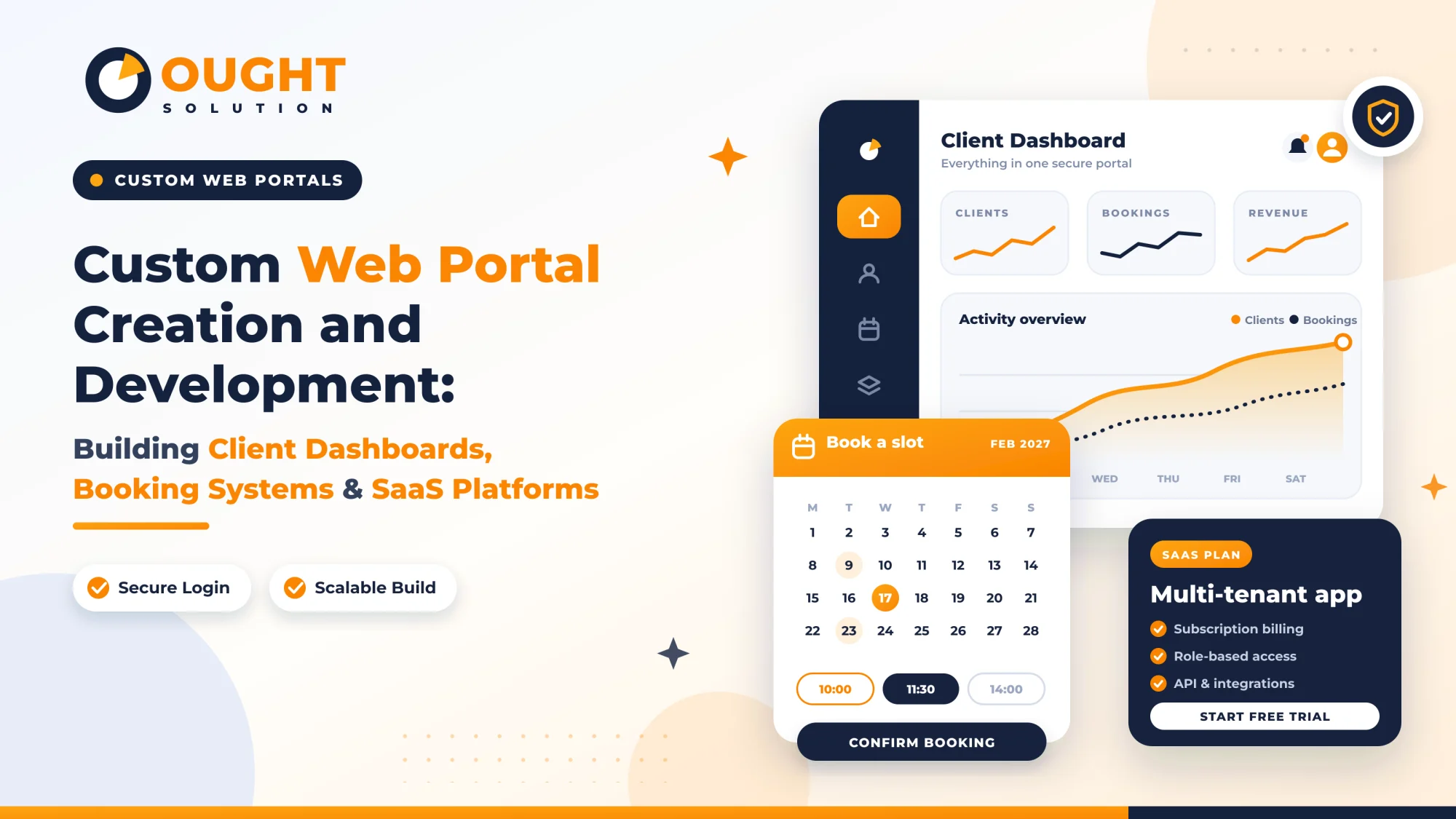
Unlike standard public web pages where every visitor sees the exact same content, a custom portal dynamically renders information based on who is logged in. A client sees their project milestones and unpaid invoices; an administrator sees system-wide revenue analytics, user permissions, and operational queues.
Core Types of Custom Web Portals Businesses Build
1. Login-Based Client and B2B Dashboards
Service agencies, logistics providers, healthcare clinics, and B2B suppliers use client portals to eliminate repetitive status-update calls.
Self-Service Document Vaults: Clients securely download contracts, compliance certificates, lab reports, or tax invoices 24/7.
Real-Time Order & Project Tracking: Live status pipelines show exactly where an order, shipment, or service ticket stands without staff intervention.
Role-Based Access Control (RBAC): Enterprise clients can add their own team members with granular permissions (e.g., restricting billing visibility to their finance manager while giving operations staff ticket-creation rights).
2. Automated Booking and Scheduling Systems
Generic calendar widgets work for simple one-on-one calls, but complex service businesses need custom scheduling engines that enforce real-world constraints.
Resource & Staff Allocation: Automatically match bookings against staff availability, room capacity, equipment inventory, or multi-location schedules.
Dynamic Pricing & Deposits: Apply peak-hour rates, weekend surcharges, or mandatory partial deposits at checkout to eliminate no-shows.
Automated Reminders & Rescheduling: Trigger instant email, SMS, or WhatsApp notifications for confirmations, calendar invites, and self-service rescheduling rules.
3. Multi-Tenant SaaS Platforms
If your business model involves monetizing proprietary workflows or industry tools, custom portal engineering forms the backbone of a Software-as-a-Service (SaaS) product.
Tenant Data Isolation: Ensure every subscribing company’s records, users, and configurations remain strictly isolated and secure within a shared cloud infrastructure.
Subscription & Automated Billing Workflows: Integrate payment gateways (such as Stripe, Razorpay, or PayPal) to handle recurring monthly/annual plans, metered usage billing, automated GST/VAT invoice generation, and failed-payment dunning sequences.
Custom Branding & White-Labeling: Allow enterprise tenants to map their own custom domains and upload their brand logos inside their workspace.
Essential Architecture Behind a High-Performing Portal
Building a web portal that stays fast and secure as user volume grows requires deliberate technical architecture from day one:
| Architectural Layer | Key Engineering Priorities | Business Impact |
|---|---|---|
| Authentication & Security | Multi-factor authentication (MFA), encrypted sessions, CSRF/SQL-injection protection, and granular RBAC | Protects sensitive client records and prevents unauthorized privilege escalation |
| Database & Backend Logic | Normalized relational schemas (MySQL/PostgreSQL), indexed queries, and asynchronous background queues | Ensures fast dashboard load times even when filtering millions of historical records |
| API & Third-Party Integrations | RESTful APIs and webhooks connecting ERP, CRM, accounting software, payment gateways, and messaging APIs | Eliminates double data entry across your existing business tools |
| Responsive UI/UX Design | Clean, mobile-first layouts with intuitive navigation, instant search, and exportable CSV/PDF reports | Reduces user onboarding friction and lowers customer support overhead |
Custom Portal vs. Off-the-Shelf SaaS Tools
Many businesses start by stitching together three or four third-party subscriptions using no-code connectors. While viable in the early stages, off-the-shelf tools create long-term constraints:
Per-Seat Licensing Taxes: Paying $20 to $50 per user every month quickly erodes margins as your team or client base scales. With a custom portal, you own the software asset outright without per-user penalties.
Workflow Compromises: Pre-built platforms force your team into rigid templates. Custom development adapts the software to your proprietary approval chains, custom tax calculations, and specialized reporting formats.
Data Ownership & Portability: Your customer data lives in a database you control completely—free from sudden vendor price hikes, feature deprecations, or platform lock-in.
How Ought Solution Approaches Custom Web Portal Development
At Ought Solution (oughtsolution.com), we design and engineer end-to-end custom web portals, client dashboards, and SaaS platforms tailored to real operational demands. Rather than relying on bloated templates, our development process focuses on clean backend architecture, fast database performance, and intuitive user interfaces:
Workflow Discovery & Data Modeling: We map every user role, permission boundary, status transition, and automated trigger before writing a single line of code.
Modular Full-Stack Engineering: Using proven server-side technologies (PHP, MySQL, modern JavaScript frameworks, and secure REST APIs), we build portals engineered for stability, speed, and straightforward maintenance.
Payment, Notification & Hardware Integrations: Whether your portal needs automated subscription billing, WhatsApp/email alerts, or real-time syncing with external APIs and biometric/IoT devices, we build seamless two-way integrations.
Deployment, Security Hardening & Scaling: We configure SSL, server-level caching, automated backups, and technical SEO foundations so your platform launches ready for production traffic.
Ready to Automate Your Client Experience?
If your team is spending hours every week manually updating spreadsheets, chasing invoice approvals, or answering routine status inquiries, it is time to centralize your operations.
Visit Ought Solution to discuss your project requirements and explore how custom web portal creation and development can streamline your workflows and scale your business.

Ought Solution Admin is the technical editorial and solutions architecture desk at Ought Solution, a global B2B IT consulting, custom ERP software, and biometric hardware integration firm. Drawing from hands-on deployments across Manufacturing Units / Plants, healthcare diagnostics, educational campuses, and corporate…