Picture a 10:00 PM shift changeover at a manufacturing plant in Pune, a logistics hub in Bhiwandi, or a 24/7 hospital in Bengaluru. Scores of tired workers line up at the gate, only for the biometric terminal to stall. "Face not detected." "Move closer." The queue backs up, supervisors resort to manual registers, and payroll disputes follow at the end of the month.
If this sounds familiar, the issue is rarely your software—it is your camera hardware. Relying on a standard visible-light terminal in dim or fluctuating lighting guarantees bottlenecks. Investing in a dedicated night shift face recognition attendance machine in India built with Dual-IR (Infrared) optics solves this problem permanently.
Here is why ordinary biometric terminals fail after sunset, and how Dual-IR technology achieves reliable, zero-light verification.
Why Standard Face Recognition Fails During Night Shifts
Most budget attendance machines use a single RGB (Red, Green, Blue) camera—similar to a basic smartphone front camera. RGB sensors depend entirely on ambient visible light bouncing off an employee's face to map facial landmarks.
In real-world Indian workplaces, this creates three major failure points:
Low-Light & Zero-Light Darkness: In dimly lit factory entrances, basement parking bays, or outdoor security cabins, RGB cameras capture grainy, underexposed images. The algorithm cannot isolate key facial geometry, leading to high False Rejection Rates (FRR).
Harsh Backlighting (The 6:00 AM Shift Change): When night-shift staff clock out at sunrise or stand in front of bright warehouse floodlights, a standard camera exposes for the bright background. The employee's face turns into a dark silhouette, rendering recognition impossible.
Glare from LED Floodlights: Some basic terminals try to compensate by blasting a harsh white LED flash into the worker's eyes. Not only is this uncomfortable during a night shift, but it also creates shiny reflections on glasses and oily skin, distorting the scan.
How Dual-IR Cameras Work in Zero-Light Environments
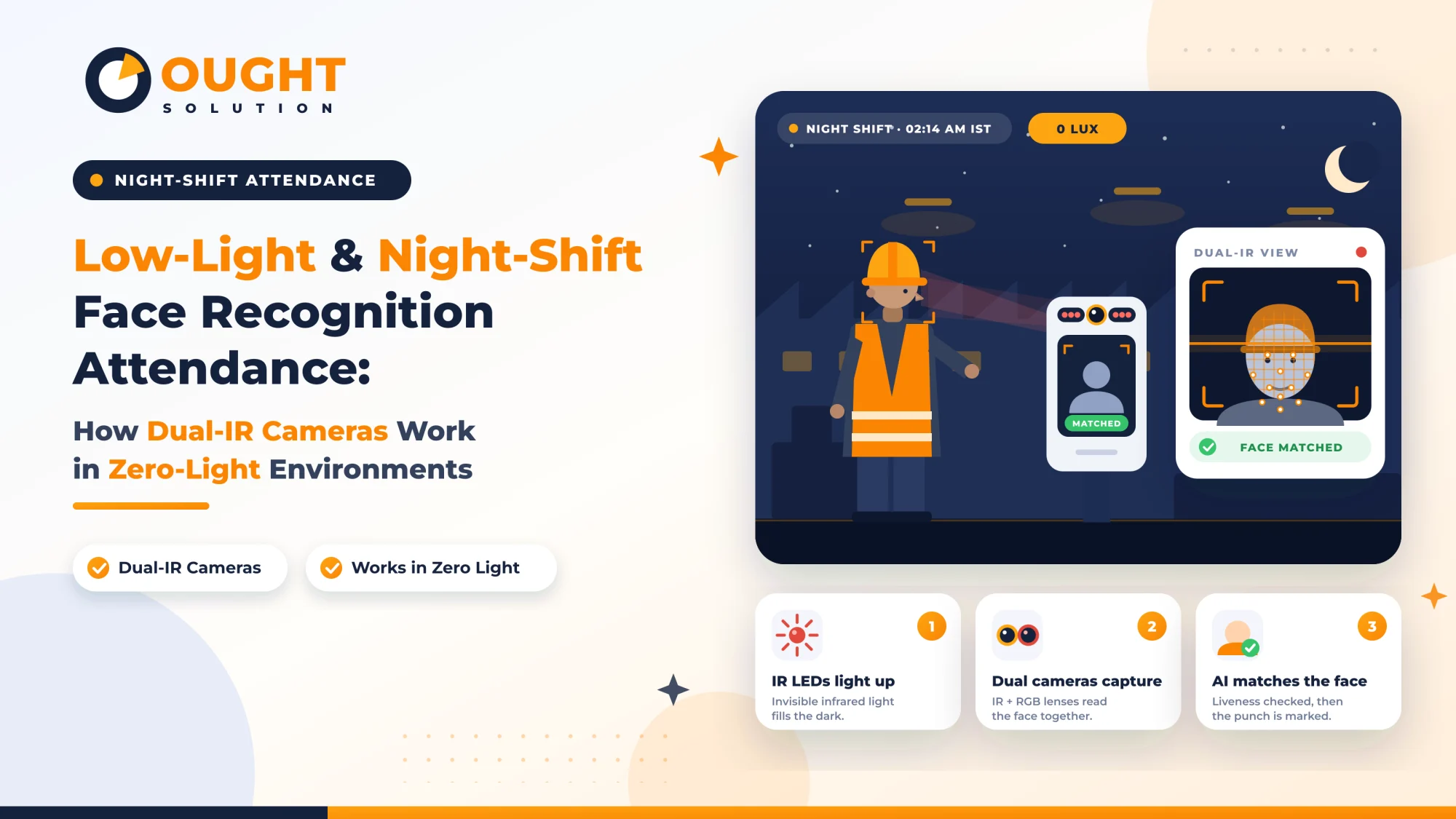
A true night shift face recognition attendance machine in India eliminates reliance on room lighting by pairing two specialized lenses: a Visible-Light (RGB) camera and a Near-Infrared (NIR) camera, backed by invisible 850nm infrared LEDs.
Here is what happens in the 0.3 seconds an employee walks up to the terminal:
Invisible Illumination: The device emits a soft, invisible near-infrared light wave that the human eye cannot see—meaning zero blinding flash for night-shift workers.
Sub-Surface Facial Mapping: Unlike visible light, which is easily disrupted by shadows or dark skin tones in low light, NIR light reflects cleanly off facial contours, eye sockets, and bone structure—even in a 0-lux (pitch-black) room.
Dual-Lens Cross-Verification: The terminal's processor simultaneously analyzes the RGB feed (for color/texture when light is available) and the NIR feed (for depth and heat-reflective structure).
Wide Dynamic Range (WDR) Balancing: Industrial-grade Dual-IR terminals include hardware WDR. If an employee stands directly in front of the morning sun or headlights, WDR balances the bright background and dark foreground in real time so the face remains sharp and readable.
Built-In Bonus: Anti-Spoofing (Liveness Detection)
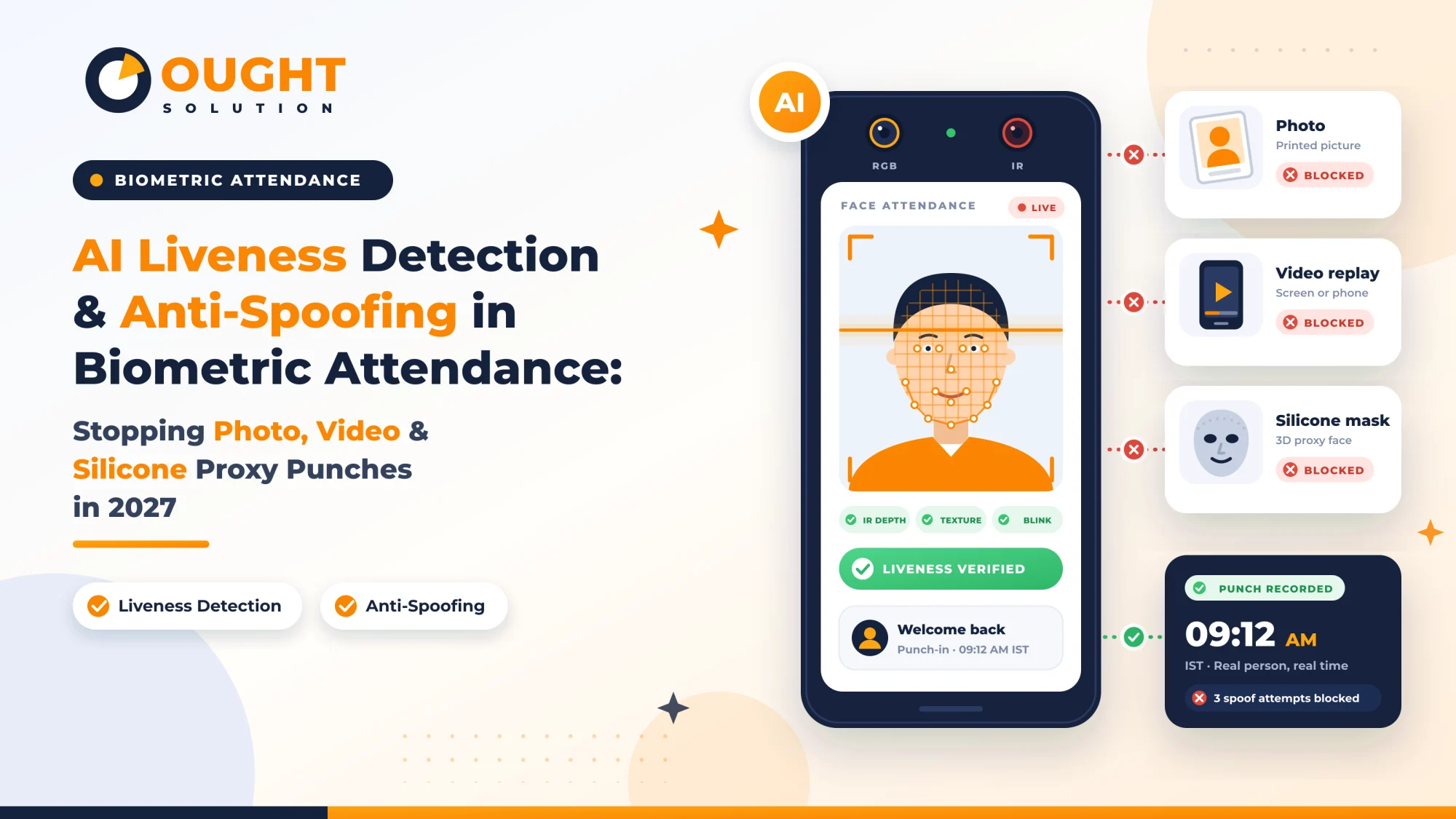
Night shifts often operate with minimal HR supervision, making them prime targets for buddy punching. Employees have been known to hold up a colleague's printed photo or a high-resolution smartphone video to a standard RGB camera—and trick it.
Dual-IR cameras make spoofing virtually impossible. Because a smartphone screen or printed paper does not reflect infrared light the same way human skin does, the NIR lens instantly detects a flat, lifeless surface and rejects the punch.
Standard RGB vs. Dual-IR Face Recognition: Quick Comparison
| Feature | Standard Single-RGB Terminal | Dual-IR Face Recognition Terminal |
| Performance in Darkness (0 Lux) | Fails completely without external light | 99.9% accuracy using invisible NIR LEDs |
| Harsh Backlighting / Glare | Silhouettes the face; frequent retries | Hardware WDR balances extreme light |
| User Comfort at Night | Blinding white LED flash | Completely invisible IR illumination |
| Anti-Spoofing (Photo/Video) | Vulnerable to HD screens and prints | True 3D/IR liveness detection |
| Verification Speed | 1.5 – 3 seconds (often requires retries) | Under 0.3 seconds (walk-through speed) |
| Ideal Environment | Well-lit corporate receptions only | Factories, warehouses, hospitals, outdoor gates |
Key Indian Industries That Need Dual-IR Attendance
Choosing the right hardware directly impacts shift compliance and payroll accuracy across high-demand sectors:
Manufacturing & Automotive Plants: Eliminates gate congestion during 24/7 rotational shift handovers, even in dusty or poorly lit shop floors.
Logistics & Cold Storage Warehouses: Workers wearing caps, safety glasses, or winter gear in dimly lit loading bays are verified touchlessly without removing gloves.
Hospitals & Healthcare Facilities: Nurses and doctors working graveyard shifts can punch in hygienically without harsh lights disturbing nearby patient wards.
IT Parks, BPOs & Security Agencies: Accurately tracks graveyard-shift teams and outdoor night guards where lighting conditions change hourly.
Upgrade Your Night-Shift Attendance with Ought Solution
Stop letting poor lighting compromise your workforce data, inflate overtime costs, or frustrate your night-shift teams. At Ought Solution, we supply and integrate enterprise-grade night shift face recognition attendance machines in India engineered with Dual-IR optics, hardware WDR, and seamless HRMS/payroll sync.
Whether you manage a single factory floor or multi-location 24/7 operations, our team helps you deploy reliable, zero-light biometric hardware tailored to your site conditions.
Ready to eliminate night-shift attendance bottlenecks? Visit https://oughtsolution.com today to request a free site assessment or live demo of our Dual-IR facial recognition terminals.

Ought Solution Admin is the technical editorial and solutions architecture desk at Ought Solution, a global B2B IT consulting, custom ERP software, and biometric hardware integration firm. Drawing from hands-on deployments across Manufacturing Units / Plants, healthcare diagnostics, educational campuses, and corporate…