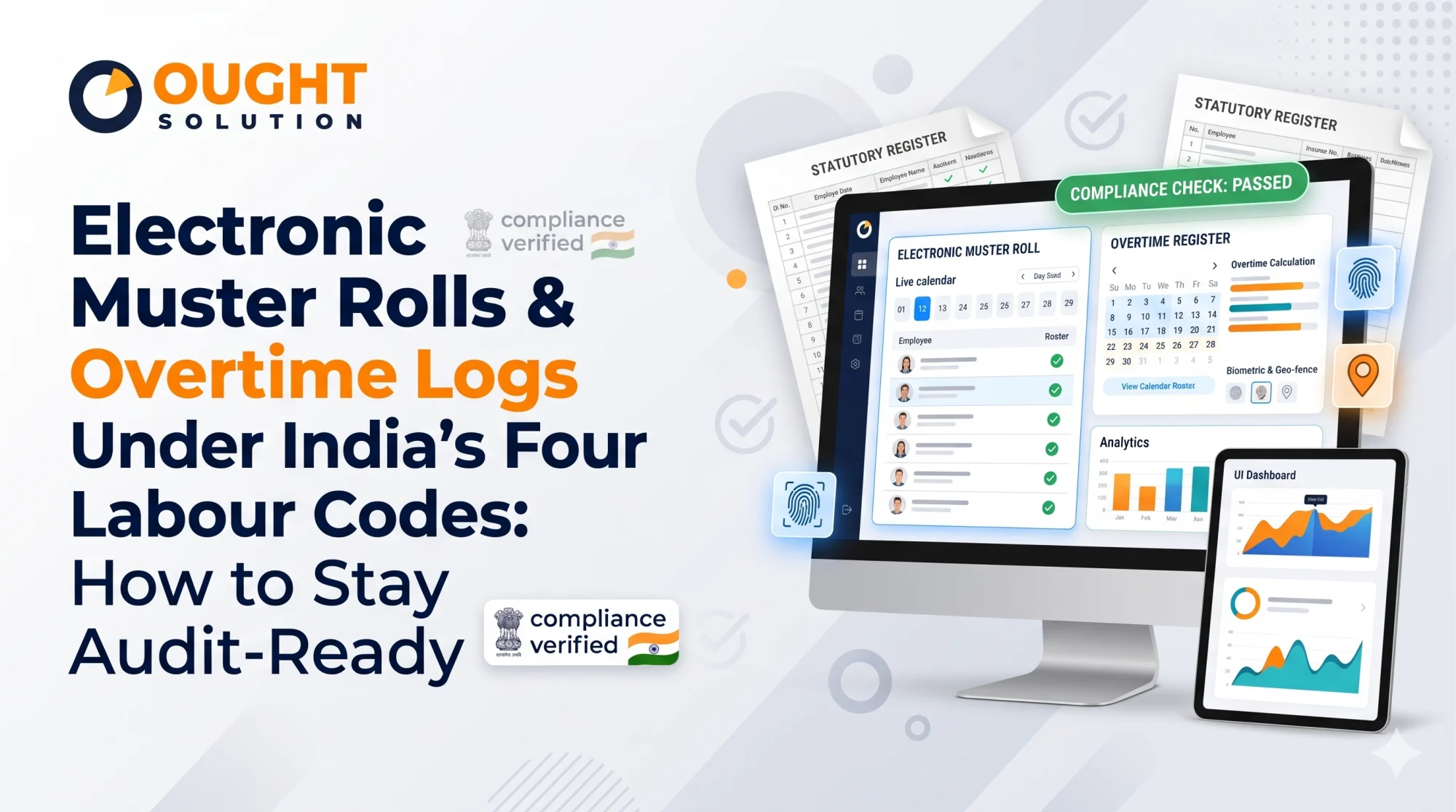
India’s consolidation of 29 central labour laws into four comprehensive Labour Codes—specifically the Occupational Safety, Health and Working Conditions (OSH) Code and the Code on Wages—has fundamentally changed how businesses track working hours. For decades, factories, shops, and establishments relied on bound paper muster rolls and manual attendance ledgers. Today, regulatory enforcement prioritizes transparency, digitization, and real-time traceability.
Achieving seamless electronic muster roll attendance compliance in India is no longer just an operational upgrade; it is a critical safeguard against statutory penalties, back-wage claims, and inspection bottlenecks. When Labour Enforcement Officers or Facilitator-cum-Inspectors conduct audits, they no longer just glance at total days worked—they cross-verify biometric timestamps, overtime authorizations, rest intervals, and net wage payouts down to the minute.
What the Labour Codes Demand for Attendance and Registers
Both the OSH Code and the Code on Wages empower employers to maintain registers electronically, provided those digital records meet strict integrity and accessibility standards. Under the draft central and state rules accompanying these codes, electronic registers must mirror prescribed statutory formats (such as unified Form A/Form B registers or state-specific equivalents) and remain readily producible during inspections.
Key statutory expectations include:
Tamper-Proof Audit Trails: Unlike an editable spreadsheet where past entries can be overwritten without trace, an electronic muster roll must log every edit with a user ID, timestamp, and reason for modification.
Granular Daily In/Out Logs: Recording a simple "P" (Present) is insufficient. Systems must capture exact shift start times, break/rest intervals, and shift end times to prove adherence to daily and weekly working hour caps.
Inclusive Workforce Coverage: Registers must account for permanent staff, fixed-term employees (FTEs), contract workers, and inter-state migrant workers—each with clear role and contractor tagging.
The High-Risk Triangulation: Muster Rolls, Overtime, and Wage Slips
During a statutory labour audit, inspectors rarely examine attendance in isolation. Instead, they perform a three-way reconciliation across your attendance logs, overtime register, and payroll outputs. Discrepancies between any two documents are the fastest trigger for show-cause notices.
| Compliance Pillar | Statutory Requirement | Common Audit Failure |
| Daily Muster Roll | Exact punch-in/out times, shift schedules, weekly offs, and leave types recorded daily. | Backdated manual overrides in Excel or missing punch-out logs defaulted to "full day." |
| Overtime (OT) Register | Prior authorization, tracking of hours worked beyond statutory limits (typically 8–9 hours/day or 48 hours/week), and 2x ordinary wage rate calculation. | Unapproved extra hours visible in biometric logs that never make it to the OT register or payroll. |
| Reconciled Wage Slips | Itemized breakdown of basic pay, allowances, overtime earnings, and statutory deductions issued prior to or on payday. | Wage slips showing flat "bonus" or "allowance" payouts instead of explicit overtime wages. |
Why Spreadsheet Tracking Fails Modern Audits
Many growing enterprises still export raw biometric data into CSV or Excel files at month-end to manually calculate payroll. From a compliance standpoint, spreadsheets lack data immutability. If an auditor requests a historical log from six months ago, an editable file cannot prove that timestamps were not altered post-facto to mask excessive overtime or missed rest breaks.
5 Steps to Make Your Electronic Muster Roll Audit-Ready
To protect your organization from compliance gaps, align your time-tracking and payroll workflows around these five controls:
Enforce Automated Biometric or Geo-Fenced Capture Eliminate manual attendance sheets across offices, warehouses, and remote sites. Use biometric devices or GPS-validated mobile check-ins that feed directly into a centralized database in real time.
Automate Overtime Thresholds and Approvals Configure your attendance engine to flag any work extending beyond standard shift hours. Require multi-level manager approval before overtime is logged, ensuring unauthorized stay-backs do not create accidental statutory liabilities.
Sync Attendance Directly with Payroll Engines Your electronic muster roll should push verified working days, paid leaves, loss-of-pay (LOP) days, and approved overtime hours directly into payroll. Eliminating manual data re-entry guarantees that your Form-compliant wage slips match your muster roll 1:1.
Preserve Immutable Edit Logs Ensure your HR system maintains a permanent version history for attendance regularizations (such as missed punches or outdoor duty requests). Auditors look favorably upon transparent approval workflows where every correction is documented.
Maintain Instant Export Readiness Inspector-cum-Facilitators often request records in prescribed statutory formats—including unified registers under the Ease of Compliance rules—within tight deadlines. Your system should generate downloadable PDF and structured CSV reports segmented by establishment, department, and worker category in a few clicks.
Streamline Statutory Compliance with Ought Solution
Navigating overlapping central and state rules under India’s Labour Codes requires technology built specifically for Indian statutory compliance. At Ought Solution, we help organizations replace fragmented attendance tracking and risky spreadsheets with unified, audit-ready HR and workforce management systems.
From real-time biometric integration and automated overtime rule engines to instant statutory register generation and reconciled wage slips, our solutions ensure your workforce records stand up to every inspection with zero friction.
Ready to future-proof your attendance and payroll compliance? Connect with Ought Solution today to schedule a personalized consultation and see how effortless audit readiness can be.

Ought Solution Admin is the technical editorial and solutions architecture desk at Ought Solution, a global B2B IT consulting, custom ERP software, and biometric hardware integration firm. Drawing from hands-on deployments across Manufacturing Units / Plants, healthcare diagnostics, educational campuses, and corporate…